

We continue our journey through the Middle East ( Iran and Oman ) with a final stop to explore the main crops in the United Arab Emirates.
The United Arab Emirates is comprised of seven emirates: Abu Dhabi, Ajman, Dubai, Fujairah, Ras Al Khaimah, Sharjah, and Umm Al Quwain. It is located in the Arabian Peninsula , bordering Oman to the southeast, the Persian Gulf to the north, and Saudi Arabia to the west and south.
The state is comprised of six sheikhs who signed the 1971 Constitution. Each emirate retains considerable political, judicial, and economic autonomy. The economy is primarily based on oil, and agriculture plays a minor role in the GDP; only 5,7% of the land is dedicated to agriculture. This, combined with saline and sandy soils, a desert climate, minimal rainfall, and scarce freshwater reserves, means that the agricultural area is insufficient to meet the needs of a population of 8,8 million. For these reasons, they rely on greenhouse farming systems with sophisticated irrigation systems.
Crops in the United Arab Emirates.
Date palm:
As is common in the countries of the area, the date palm is a pillar of their culture and gastronomy, and therefore cannot fail to be so in their agriculture. This plant, known as the "Tree of Life" or the "Princess of the Desert," has been cultivated in the region for more than 5 years and represents 90% of the country's fruit crop.
One interesting fact is that only female palm trees bear fruit, which is why in commercial plantations, only 10 out of every 100 trees planted are male palms.
Grasses and Alfalfa:
These forage plants belong to a group of herbaceous plants, either annual or perennial, from the grass or legume families. These forages constitute an important part of animal feed worldwide. Livestock can utilize them directly through grazing or by cutting them.
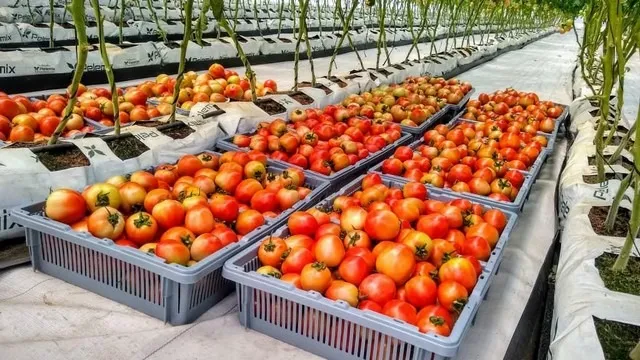
Tomato:
This product, native to Central and South America, began to be cultivated around 2500 years ago in the area that is now Mexico, according to the most recent evidence. In Europe, it was used as an ornamental plant until the 19th century, when it began to be cultivated on a massive and widespread scale as a food source.
Cucumber:
This plant, from the Cucurbitaceae family, is native to India, where its cultivation dates back more than 3000 years. From there, it spread throughout Asia, the Middle East, and Europe during the following centuries, eventually reaching the Americas with the Spanish conquistadors.
In addition to the vegetables and fruits already mentioned, in the United Arab Emirates you can find small plantations of other products such as pumpkins, eggplants, onions, peppers, zucchini, and potatoes, as well as limes, grapefruits, and mangoes.
At MSC, we hope you find this article interesting. For more information about the sector, please visit our website.