

Tomatoes in the Desert: How to Optimize the Balance Between Water and Energy to Maximize Profit
How much does it really cost to produce sustainably in the desert? To answer this question with validated scientific data, we used the latest research from the prestigious Wageningen University (WUR ) as a reference . In the following article, the MSC Greenhouses team analyzes the strategic dilemma faced by agricultural projects in arid environments.
The Desert Dilemma: Water or Energy? The Strategic Decision in High-Tech Greenhouses
In semi-arid or desert regions, greenhouse tomato production requires significant resource consumption to maintain optimal temperature and humidity levels. Research from Wageningen University precisely quantifies the trade-off between water and electricity use, providing essential financial guidance for agricultural investors.
Two Technological Strategies for the Same Goal
The study evaluates the resources needed to harvest 1 kg of fresh tomatoes using two radically different approaches to refrigeration and climate management in terms of their water and energy consumption:
1. Evaporative Cooling: Maximum Energy Savings
This traditional system (based on evaporative panels and extractors or pad and fan ) uses water evaporation to cool the air in the greenhouse.
-
Advantage: It requires a very simple electrical infrastructure, consuming approximately 0.7 kWh per kilo of tomatoes just for the operation of the extractors.
-
Disadvantage: Its water footprint is considerable. Depending on the ambient humidity, water consumption varies, but it rarely falls below 45-50 liters per kilogram.
2. Mechanical Cooling: Absolute Water Efficiency
Typical of technologically “closed” or “semi-closed” greenhouses, this system dispenses with traditional evaporative cooling and uses mechanical refrigeration units ( chillers ).
-
Advantage: When dehumidification systems are included, significant water efficiency is achieved. Operating in a closed circuit, the system condenses and recovers more than 80% of the water transpired by the crop for reuse within the system. This allows for the production of 1 kg of tomatoes using only 4.2 liters of water , a figure up to 10 times less than in evaporative greenhouses and 40 times less than traditional commercial practices. Where does the recovered water come from?
-
Instead of ventilating and wasting that resource, the air passes through dehumidifiers and over the cold surfaces of the chillers (mechanical cooling) , where the water vapor condenses, is collected (collecting more than 80% of the total), and is returned disinfected to the system
-
-
Disadvantage: The demand for electrical energy increases significantly to run the cooling system and pumps, reaching an average of 6 kWh per kilogram of tomatoes produced.
Comparison of Resources (Per 1 kg of Finished Tomato)
The following table summarizes the actual data validated by the Wageningen research after its experimental trials:
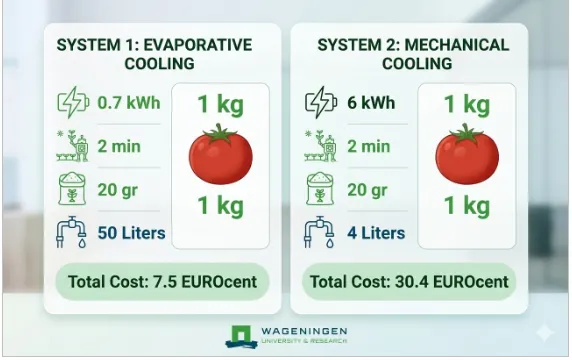
Note: Generic agronomic parameters such as labor or specific fertilizers were not part of the scope of this WUR study's balance of flows.
Business Vision: How to choose the right technology?
The choice of structure does not depend on which system is structurally "better", but on the availability, environmental limitations and local price of resources in each territory:
-
Areas with accessible water: Evaporative cooling continues to offer the greatest immediate economic viability due to its lower direct electricity requirements. Thanks to the use of plastic panels, it is possible to use saline water, which involves an even lower cost. However, the loss of efficiency of the evaporative system in hot but humid areas must be taken into account.
-
Areas with critical water scarcity. The closed greenhouse with mechanical cooling ceases to be an alternative and becomes an environmental necessity.
Conclusions and Economic Viability Criteria
Research from Wageningen University provides a precise mathematical formula for variable costs: mechanical cooling only equals the operating expenditure (OPEX) of evaporative cooling when the cost of 10 liters of water is equal to or greater than the cost of 1,75 kWh of electricity . However, for a capital investor, this rule is incomplete if the CAPEX threshold and the payback period are not taken into account.
1. The CAPEX (Capital Expenditure) Barrier
Implementing a closed system with this level of technology can double or triple the CAPEX per square meter compared to a greenhouse equipped with evaporative panels and extractors ( pad and fan ).
2. OPEX (Operating Costs) Analysis.
The electricity required to continuously operate the compressors and fans of the mechanical system far exceeds the market value of the liters of water saved. Financially, paying for the electrical operating expenses (OPEX) to save water extends the investment payback period beyond the equipment's useful life.
To help you assess the true impact of these variables on your business model, please contact us at info@invernaderosmsc.com . We would be pleased to assist you in explaining these scenarios in detail, analyzing infrastructure costs, and exploring the viability of these greenhouse investments in the region.